Phoenicia Publishing
  • BLOG
  • CATALOGUE
  • SUBMISSIONS
  • ABOUT US
  • CONTACT
  • ART SHOP
  • BLOG
  • CATALOGUE
  • SUBMISSIONS
  • ABOUT US
  • CONTACT
  • ART SHOP
Picture
96 pages, 9" x 10". November 2023. 
$22.00 US and CA, $24.50 other countries. Shipping/handling added at checkout.
Order directly from publisher:
Choose Destination

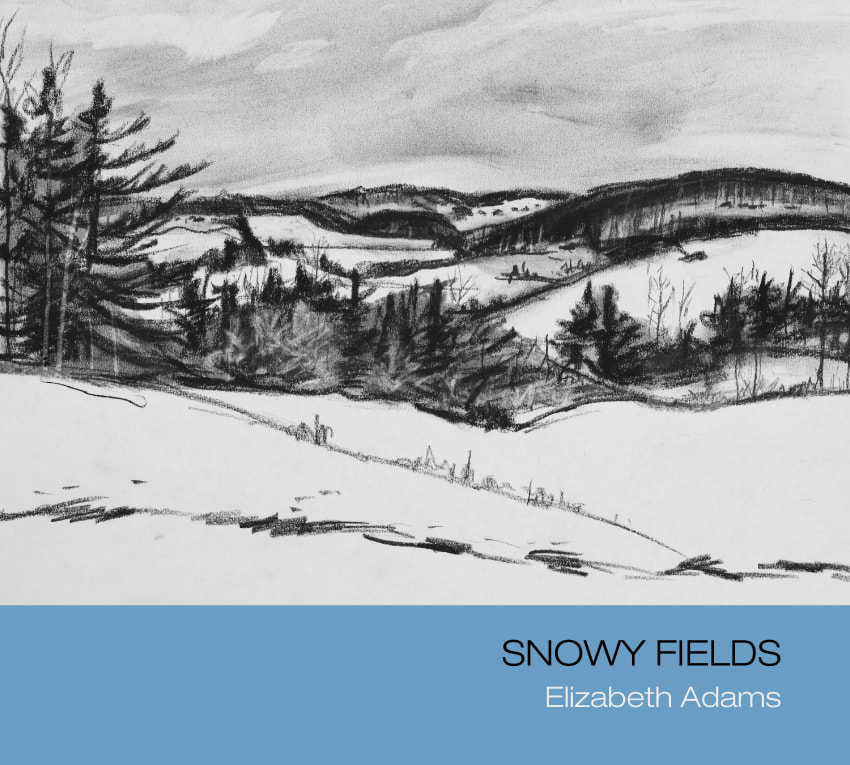
Watch the cover drawing being made, in this speeded-up 1.5 minute video.
From the artist's essay in Snowy Fields, describing the creation of the drawing "Tangled Stream."

"One night when I couldn’t fall asleep, I got up around midnight, wrapped myself in a sweater, and went to my workroom. A blank sheet of paper shone in the artificial light; pieces of charcoal lay beside it. All right, I thought, let’s do something with these wakeful hours. I dipped my forefingers into a jar of charcoal powder, smearing it onto the paper with my hand to form an overcast sky; a soft charcoal stick rapidly suggested the basic composition: a stream with snowy banks, overgrown with thickly-overlapping, dark-branched shrubs and trees. I roughed in the water, but spent most of my time that night drawing the tangled branches. As I drew, I felt the anger and frustration moving out of my body, and finding an outlet on the paper. The branches needed vigorous pressure and energy to convey their dark disorder, and I drew them that way. They weren’t lovely, they weren’t pretty, they didn’t make sense or harmony, they were simply there in their brokenness and cold disarray. When the trees were finished, I turned to the water, and was surprised to see it begin to flow and swirl as I worked with compressed charcoal and an eraser. The stream was in the center of the picture, but it was unclear where it was going, or where it had come from; in the distance, it seemed to branch. Light shone on it, though, and the water was moving."

Just published!
Snowy Fields

drawings and writing by
Elizabeth Adams
with an essay by Michael Szpakowski

" When I look at her work I sense truth. And this sense is both part of the aesthetic impact of the work, the burst of joy that accompanies the experience of art which takes us somewhere we haven’t been before, to know and feel things we had not previously known and felt (often about things we have seen many times before, either in real life or in depiction), but also arises out of its structural, compositional, colouristic, merits."
Michael Szpakowski, artist, writer, composer and educator
Snowy Fields begins with the presentation of twenty charcoal drawings of the rural landscape of central New York State,  completed during the winter of 2022-23, following the death of the artist's father. Although she lived in the large city of Montreal, she had begun traveling frequently to the quiet, pastoral hills and fields of her childhood, which she began to draw,  contemplating her compulsion to create the series that was taking shape on her studio wall. As winter gave way to spring, she wrote a long reflection on identity, place, grief, and -- centrally -- her artistic process and what it eventually revealed to her. That essay forms the second part of the book. It is followed by an essay exploring Elizabeth Adams' artwork, and this series of drawings in particular, by Michael Szpakowski, who has followed her work and engaged with her in conversation over a period of many years.

Picture
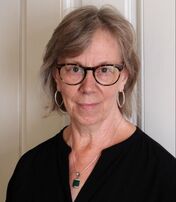
Elizabeth Adams is a writer, artist and publisher. She grew up in the small rural towns on which this book is based, graduated from Cornell University, and spent 35 years in Vermont as a graphic designer and communications specialist before moving to Montreal in 2005 and becoming a dual Canadian-American citizen. Her biography of Bishop Gene Robinson, Going to Heaven, was published in 2006, and her essays have appeared in many publications. She has illustrated, edited and designed numerous books, and her artwork is in private collections worldwide. She was a founder/co-managing editor of the e-zine qarrtsiluni, is the founder/editor of the independent press Phoenicia Publishing in Montreal, and her blog The Cassandra Pages has considered questions of arts & letters, culture, nature, and spirit since 2003.


... I was conditioned early to see the landscape around us as particularly beautiful, but even now, after living and travelling in many other places, I still find it has a special quality, owing partly to the underlying structure of the land itself, which is never more apparent than in winter. The gently rolling hills are high enough to be interesting, but not so tall as to dominate any particular view, the rivers are not wide at all, and the scale of the resulting hills and valleys has, over time, encouraged a mixture of woods and fields, orchards and hedgerows, with the occasional huge old tree standing by itself. Everything fits into a harmonious, balanced whole that is never monotonous. The scene varies and changes as you go around each bend in the road. Many of the fields that were cleared long ago are still cultivated, and you continue to have the sense of a succession of individual properties, many of which were farms, even if they are no longer in use. It is a landscape of intimacy.
HOME        CATALOGUE         BLOG          CONTACT